What makes a possessió? History, layout and the signs of an authentic estate
The architecture, history and details that distinguish a true Mallorcan possessió — and how to recognise them.
 Rolf Herbert ZscharnackOctober 20266 min read
A word with a long history
On Mallorca, almost every rural property is called a finca. A possessió is something more specific: a historic agricultural estate with a main house, outbuildings and its own land, which for centuries formed the backbone of the island's rural economy.
The origins of many possessions go back to 1229, when King James I of Aragon conquered Mallorca and divided its land among the nobles who had joined him. The new estates often grew out of earlier Islamic farmsteads, the alqueries — which is why some possessions still carry Arabic-rooted names, and why many have been in the hands of the same families for generations.
The possessions offered today are typically between around 170 and 700 years old. Genuinely new ones have practically never been built — which is precisely what makes them so rare.
The heart of the estate: the cases
At the centre of every possessió stand the cases — the group of buildings from which the estate was run. They are usually arranged around an enclosed courtyard, the clastra, entered through a large arched gateway. Within this ensemble, each building had its purpose:
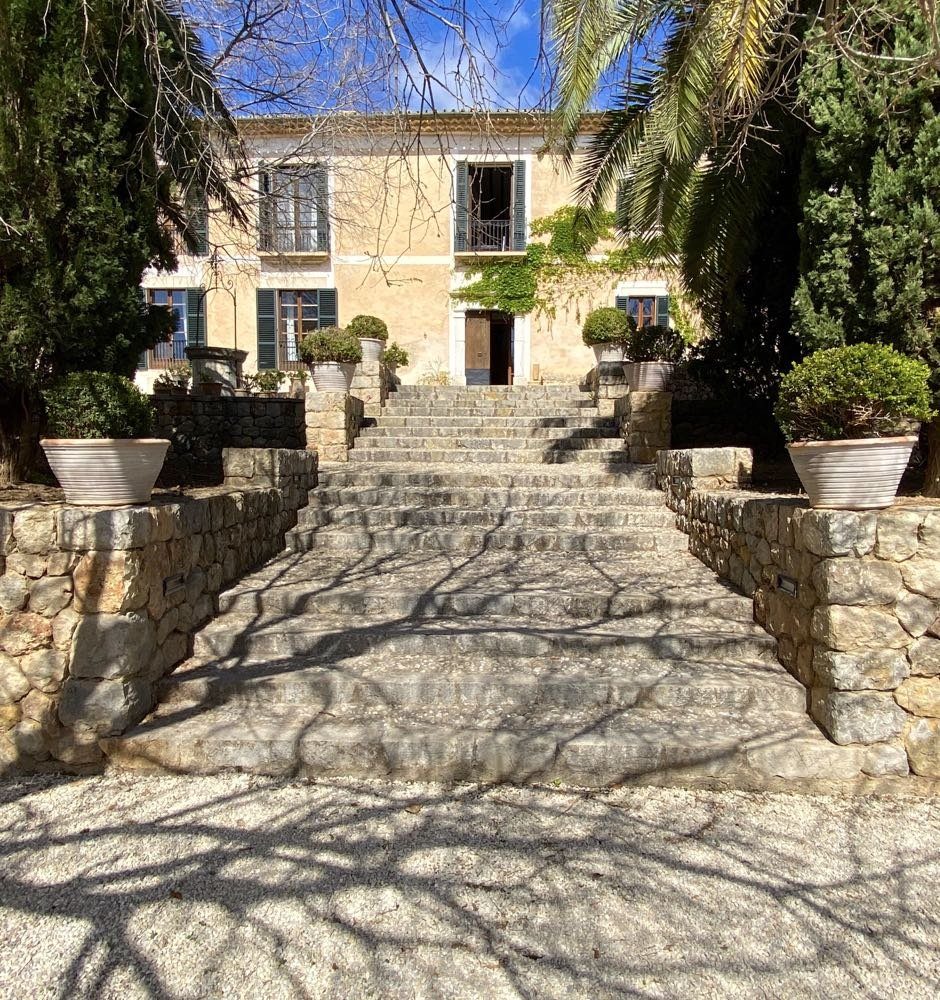
- Casa dels senyors — the owners' house, the most representative part, often with a loggia, a grand staircase and reception rooms with high ceilings.
- Casa de l'amo — the house of the estate manager, who lived on the land and ran the farm.
- Tafona and celler — the olive-oil mill and the wine cellar, the economic heart of many estates.
- Chapel and tower — a private oratory on many estates, and on those near the coast often a defence tower.
- Porxo — covered, often open areas once used to shelter carts, tools or the harvest, today frequently turned into beautiful living spaces.
Around the cases lies the land: dry-stone terraces (marjades), olive and almond groves, threshing floors, cisterns, wells and irrigation channels — the infrastructure that once made the estate self-sufficient.
Many faces, one character
Over the centuries, each estate was shaped by the needs and ambitions of its owners. Some kept a fortified, almost austere character; others were transformed into baroque or neoclassical country palaces with formal gardens. Well-known examples that can be visited include Son Marroig in Deià, Alfàbia and Raixa in Bunyola.
This variety is part of their appeal. No two possessions are alike — and each tells its own story in stone, timber and landscape.
The signs of an authentic estate
With some experience, the authenticity of a possessió can be read in its details. These are among the features I look for first:
- An original layout around the clastra, with the historic buildings still recognisable.
- Marès sandstone arches, carved doorways and, sometimes, a family coat of arms above the gate.
- Original timber ceilings, historic floor tiles and stone staircases.
- Working elements of the old estate: a tafona with its press, a cellar, cisterns, a threshing floor.
- Land that still belongs to the house — terraces, groves and the views they protect.
- A name, often beginning with Son, and a documented history that connects the house to its families.
Not every estate has all of these — and none needs to. Many possessions have been carefully restored and modernised, and the best restorations are those in which the history remains visible while the house offers every comfort of today.
Why possessions are so sought after
A possessió cannot be built, copied or replaced. It combines centuries of history with a landscape that is protected in its own right, and with a sense of space and privacy that is rare on an island. For many buyers, that is exactly the point: they are not looking for a house, but for a place with a story — one they will continue.
Owning one comes with a little more care than owning a modern villa, and every owner of a historic estate knows that. What they receive in return is something unique: a house that has stood for centuries, in one of the most beautiful landscapes of the Mediterranean.