Buying a listed property: what heritage protection means for owners
Why heritage protection is less a restriction than a guarantee — and how owners live comfortably in listed houses today.
 Rolf Herbert ZscharnackOctober 20266 min read
A protection, not an obstacle
Many of Mallorca's possessions, manor houses and palacios are listed as part of the island's architectural heritage. For some buyers, the word “listed” sounds like a long list of prohibitions. In practice, it is closer to the opposite: a guarantee that the qualities which make the house valuable — its façade, its structure, its character and often its surroundings — will be preserved, by you and by everyone around you.
Owners of listed houses on Mallorca live in them comfortably every day, with modern kitchens, bathrooms, heating and cooling. Protection simply defines how these things are integrated: with respect for the building.
Levels of protection
On Mallorca, protected buildings are recorded in the heritage catalogue of each municipality, which assigns them a level of protection. The highest category is the Bé d'Interès Cultural (BIC), reserved for buildings of particular historic significance; for these, works are approved not only by the town hall but also by the heritage commission of the Consell de Mallorca, which has its own responsibility for protected monuments.
The level of protection determines which elements must be preserved. As a rule of thumb:
- Façades, volumes and roofs are usually preserved in their historic form.
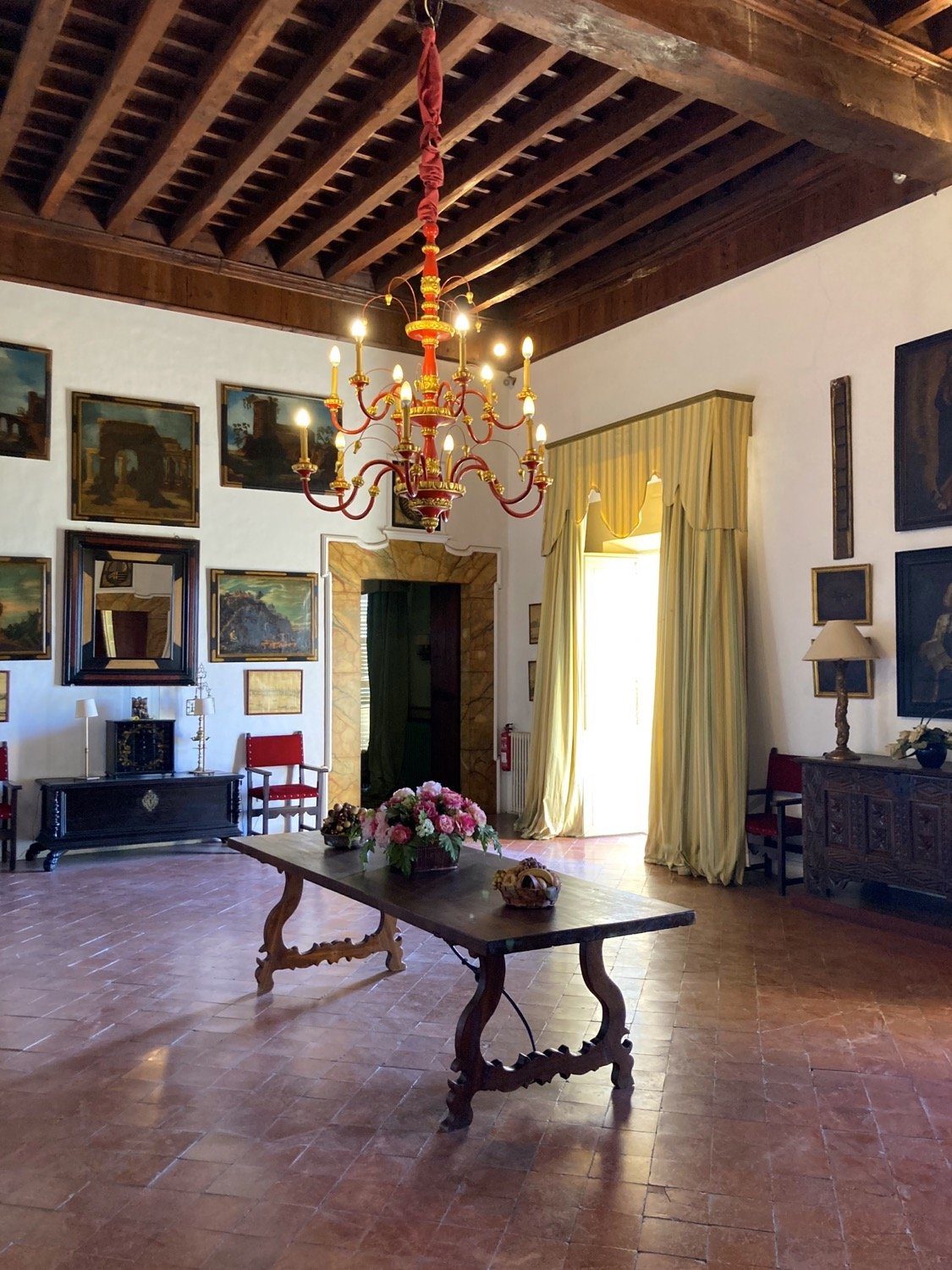
- Characteristic elements — arches, staircases, timber ceilings, historic floors — are kept and restored.
- Interiors can often be adapted to modern life, depending on the level of protection.
- Technical installations — heating, cooling, electrics, water — can be renewed throughout.
Exactly what applies to a particular house is set out in its catalogue entry, and your lawyer and architect will review it as part of the preparation for purchase.
What owners typically do
The most common projects in listed houses are entirely compatible with protection: restoring timber ceilings and stonework, renewing roofs with traditional tiles, installing underfloor heating beneath restored floors, integrating discreet air conditioning, creating modern kitchens and bathrooms within the existing rooms, and bringing the gardens back to life.
Many buyers find that these projects are the most rewarding part of ownership. Bringing out the original beauty of a house — and adding today's comfort with a light hand — creates a home that no new building can match.
A few practical points
- Work with the right architect. Architects experienced with historic buildings know the rules, the authorities and the craftsmen — and design solutions that are approved smoothly.
- Plan time for licences. Approvals for listed buildings take somewhat longer than for ordinary houses. With good preparation, this simply becomes part of the timeline.
- Use traditional materials. Lime, marès stone, Arabic roof tiles and solid timber are not only required in many cases — they are also what makes the house feel right.
- Keep the documentation. A well-documented restoration adds lasting value to the property.
Why protection adds value
A protected house belongs to a small, finite group of properties that can never be multiplied. The same rules that guide your restoration also protect the character of the house for the future — and, in many cases, the landscape or historic setting around it.
For buyers of this kind of property, that is not a limitation but part of the attraction. You are acquiring something genuinely irreplaceable, and the care it asks for is part of what keeps it that way.